A bottle order can fail before printing begins: the wrong material, unusable capacity, leaking lid or unsupported food-contact claim can undermine an otherwise strong promotion. By the end, you will have a practical way to specify the bottle, approve its branding, test the finished units and compare suppliers before placing a bulk order.
Key takeaways
- Define usable capacity separately from brimful volume.
- Specify food-contact safety, closure performance and cleaning instructions.
- Match printing or engraving to the bottle material and artwork.
- Put tests, acceptance criteria and delivery dates in the RFQ.
Specify the bottle by material, construction and usable capacity
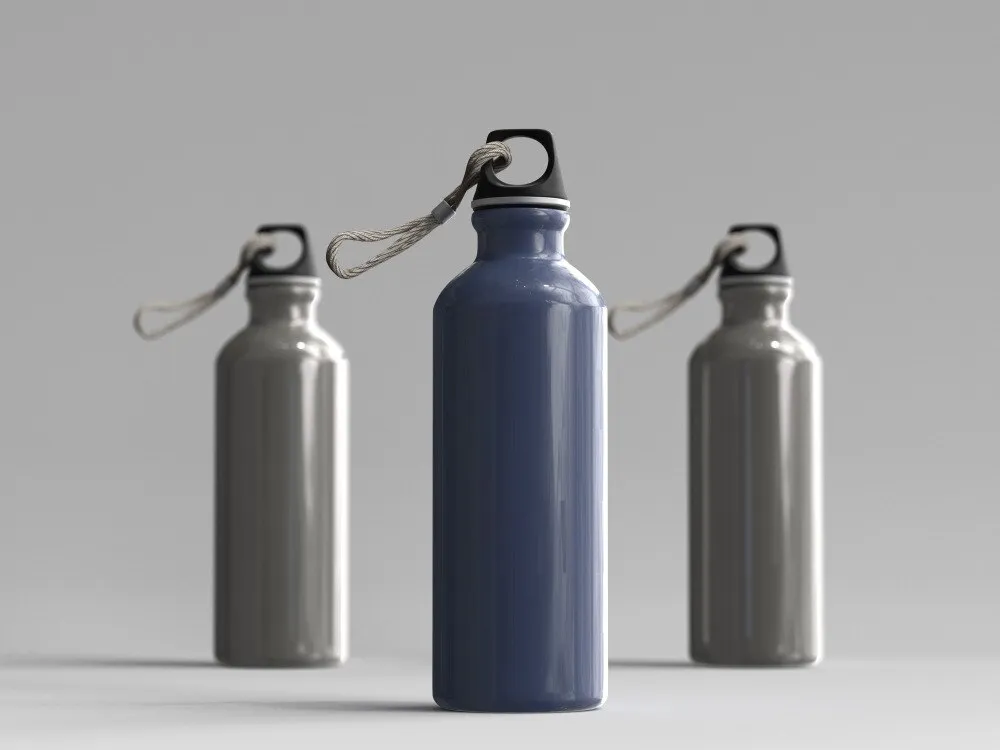
A 750 ml bottle is not one specification: compare its material, wall construction, usable fill volume, shape and decoration surface before comparing price. A customised bottles manufacturer in bengaluru should state whether capacity means usable fill or brimful volume. Ask for a drawing or sample showing the shoulder, cap or straw intrusion and required headspace.
| Material and construction | Practical difference | Check before choosing |
|---|---|---|
| Single-wall stainless steel | Durable, moderate weight, no thermal insulation | Confirm wall gauge, finish and engraving area |
| Vacuum-insulated stainless steel | Double wall, better temperature retention, heavier and costlier | Check diameter, base stability and cup-holder fit |
| PET | Lightweight and economical | Confirm food-contact grade, wall rigidity and scratch resistance |
| Tritan-type copolyester | Clear, reusable plastic appearance | Check clarity, colour options and decoration compatibility |
| Aluminium | Light metal body, often paired with an inner coating | Confirm lining, dent resistance and print surface |
| Glass | Neutral taste and premium appearance, but breakable | Specify protective sleeve and transport packing |
Order 500 ml, 750 ml or 1 litre as usable capacity under normal filling, not as a catalogue headline. Compare bottle height and diameter too: a 1 litre model that does not fit a car cup holder may be less useful than a 750 ml model.
Record body colour, gloss or matte finish, base shape, cap profile and the actual decoration panel.
Do not treat an IS 14543 reference as proof that an empty promotional bottle passed leak, impact, thermal or food-contact tests; that standard concerns packaged drinking water.
Set safety, closure and care requirements before ordering
State the intended liquid and use before approving the lid. A screw cap with a silicone gasket suits everyday still water; a flip-top or straw lid improves one-handed use but adds parts that can trap residue. Specify whether the bottle must handle carbonated drinks, because pressure can defeat closures designed only for still liquids.
| Closure option | Main risk | Specification to request |
|---|---|---|
| Screw cap | Cross-threading or gasket failure | Thread design, gasket material and torque or closure test |
| Flip-top or straw lid | Hinge, valve or straw leakage | Lock mechanism, removable parts and inverted leak test |
| Sports cap | Valve contamination or seepage | Valve construction, seal test and cleaning access |
Record these requirements in the purchase specification:
- Require food-contact suitability for the bottle, cap, gasket, straw and colour coating. Ask for material declarations and relevant migration or compliance documents; “BPA-free” alone is not evidence.
- Define the supplier’s tested temperature range for the exact bottle and lid, including hot-fill restrictions. Do not assume an insulated bottle accepts boiling water.
- Require an inverted leak test on assembled units, with the sample size, test duration and replacement procedure stated.
- Specify hand-wash only unless the exact bottle-decoration combination has passed repeated dishwasher heat, detergent, abrasion and drying cycles.
- If bottles arrive filled with water, require packaged-drinking-water compliance, batch identification and statutory labelling. IS 14543 applies to packaged drinking water, not automatically to empty promotional bottles.
A branded water bottles supplier should also document acceptable scratches, pinholes, print damage and seal defects before production.
Match the branding method to the surface and artwork
Choose the decoration after matching the artwork to the bottle’s material, coating and shape. A method that looks sharp on powder-coated steel can peel from plastic, while a detailed logo can lose clarity when reduced to a one-colour print. Request a decorated sample before approving custom bottles in Bengaluru.
| Method | Best surface and artwork | Decision point |
|---|---|---|
| Screen printing | Smooth metal or plastic; solid one- or few-colour logos | Cost rises with each screen and colour; fine gradients and photographs are poor candidates. |
| UV printing | Flat or gently curved coated metal, plastic or glass; detailed multicolour artwork | Check adhesion and rub resistance, especially on powder-coated or low-surface-energy plastic. |
| Laser engraving | Uncoated stainless steel or coated metal with a contrasting underlayer; simple marks and names | Approve the exact finish, contrast and engraving depth; it will not produce a coloured logo on plain steel. |
| Sublimation | Polyester-coated bottles or suitable polymer surfaces; photographic, full-colour artwork | It cannot transfer directly to every stainless-steel or plastic bottle. |
| Vinyl labels | Smooth, dry surfaces; short campaigns, variable names or small quantities | Seams, washing and repeated handling can lift the edges. |
| Full-wrap decoration | Straight, smooth cylindrical bottles; artwork needing near-360-degree coverage | Confirm the seam, artwork alignment and usable area around the cap and base. |
For a small logo on an insulated bottle, laser engraving or screen printing often gives a cleaner, more durable result than a label. Choose UV or sublimation for colour detail, and use a full wrap only when the bottle shape supports uninterrupted coverage. Ask for colour references, artwork proofs and a rub-and-wash sample.
Build an RFQ with tests, acceptance criteria and realistic dates
Put the RFQ on measurable terms before requesting a production slot. Ask for a dated quotation covering the bottle, cap, gasket, decoration, packing, freight and replacement of rejected units. State that the approved pre-production sample is the reference for colour, logo position, finish and construction.
1. Request a pre-production sample within five working days of artwork approval. Approve it only after checking capacity, dimensions, cap fit, thread quality, logo size and print registration within ±1 mm.
2. Require a leak test on 10 randomly selected bottles. Fill, close and invert each for 24 hours; accept zero leaks, seepage or cap loosening. Ask for photographs or a signed inspection record.
3. Define appearance limits: no pinholes, scratches through the finish, dents, peeling, cloudy patches or visible contamination. Set a written logo colour tolerance, such as an agreed Delta E limit or signed physical swatch, and reject shade variation outside it.
4. Set quantity at the quoted count with no short shipment, or specify a tolerance such as ±2% and require replacements within seven calendar days of written rejection.
5. Separate dates for artwork approval, sample approval, blank-bottle arrival, decoration completion, final inspection and dispatch. Allow at least 10 working days after sample approval for standard promotional bottles in Bengaluru; confirm whether stock comes from outside the city.
Ask for the exact bottle-decoration combination’s dishwasher test evidence. Otherwise specify hand-wash only. If bottles are supplied filled, request packaged-water compliance and batch labelling; IS 14543 does not prove an empty bottle’s performance.
Choose a supplier that can manage the complete production decision
A capable supplier converts your brief into a controlled production file, not merely a logo mock-up. Ask for one approved sample and a written acceptance sheet covering material, construction, colour code, logo colour tolerance, print-registration tolerance, acceptable scratches or pinholes, quantity tolerance, leak-test sample size and the replacement procedure.
| Evidence to request | What it proves | Warning sign |
|---|---|---|
| Material declaration and migration or food-contact documents | The bottle suits direct drinking-water contact | “BPA-free” is the only evidence |
| Preproduction sample beside approved artwork | Size, placement, shade and registration are controllable | Bulk production starts from a digital preview |
| Separate dates for sample, blank-bottle arrival, decoration and dispatch | The slowest component has been planned | One headline lead time |
| Written leak-test record and defect remedy | Failures have a measurable outcome | “We will inspect everything” |
| Filled-water compliance file | Packaged drinking water is being handled correctly | IS 14543 is used as proof for an empty bottle |
Tell the branded water bottles supplier whether you need empty promotional bottles or bottles filled with drinking water. Filled units require packaged-drinking-water controls, batch identification and statutory labelling; an empty bottle carrying your logo does not become packaged drinking water.
Do not treat IS 14543 as proof of an empty bottle’s leak, impact, thermal or food-contact performance.
Ask DRVY ENTERPRISES BLR to identify who controls bottle sourcing, cap and gasket availability, colour approval, decoration, inspection and packing. That answer reveals whether you are dealing with one accountable customised bottles manufacturer in Bengaluru or several disconnected vendors.
Related product
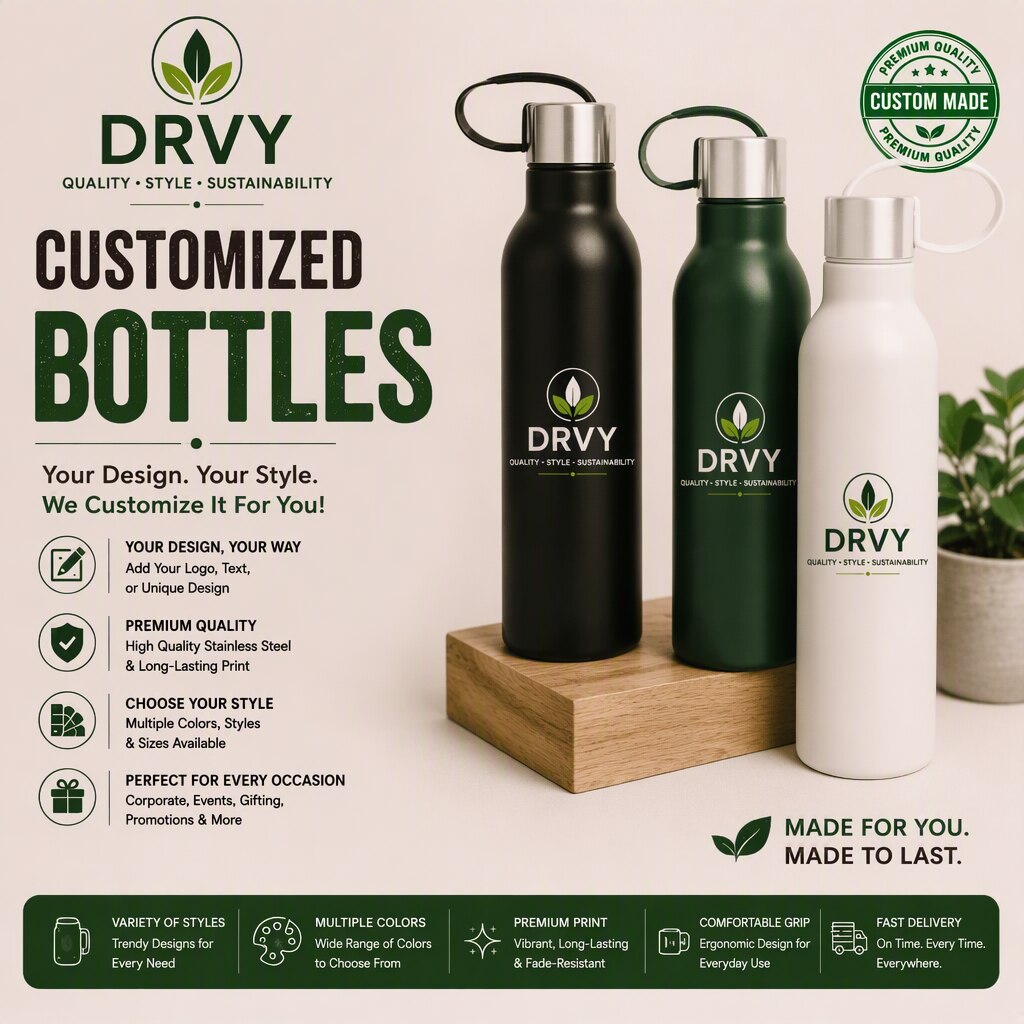 | Customised Bottles Manufacturer in Bangalore, DRVY At DRVY, we create tailored bottles for brands, corporate gifting events, and promotional efforts. View product → |
Frequently asked questions
What should you specify when ordering customised bottles?
State the material, wall construction, usable fill capacity, shape, decoration area and closure type. Ask for a drawing or sample that shows shoulder, cap or straw intrusion and required headspace.
Which safety and care requirements should a bottle order include?
Set food-contact requirements, leak testing, closure performance, cleaning instructions and restrictions for hot liquids, dishwashers or repeated use before approving production.
How do you choose the right branding method for a bottle?
Match the method to the surface and artwork. Screen printing suits simple designs on suitable surfaces, while laser engraving, transfer printing or wraparound labels fit different materials, curves and colour requirements.
What should a bottle RFQ contain?
Include technical drawings, samples, artwork files, decoration tolerances, test requirements, inspection standards, packaging details, approval milestones and a realistic production and delivery schedule.
Keywords