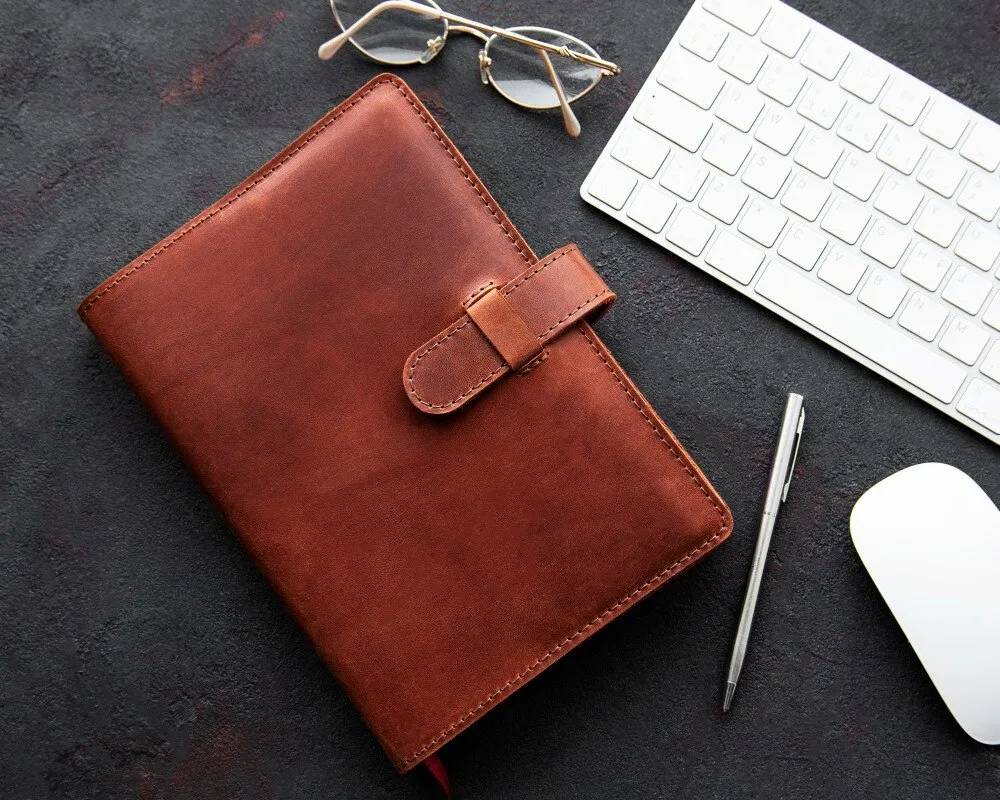
Choosing an event diary involves more than adding a logo to a stock notebook: size, paper, binding, branding method, quantity and delivery timing all affect whether attendees use it or leave it behind. You will be able to match the diary to your audience, brief a supplier accurately and schedule production without creating avoidable artwork, packing or delivery problems.
Key takeaways
- Choose A5 for notes and schedules; choose A6 when attendees need pocket portability.
- Specify paper weight, binding, page layout and extras before comparing supplier quotes.
- Set quantity from confirmed attendees, speaker needs and a small replacement reserve.
- Approve a physical proof after checking logo colour, dates, margins and cover finish.
Choose the diary format around how attendees will use it
Choose A5 for most conference and workshop attendees: its 148 × 210 mm page, defined by ISO 216, gives room for schedules, speaker notes and sponsor information without becoming difficult to carry. Choose A6, 105 × 148 mm, when pocket portability matters more than writing space.
| Event audience | Recommended format | Page layout |
|---|---|---|
| Conference delegates | A5, dated or undated | Daily or weekly planning, agenda pages, speaker notes and contacts |
| Workshop participants | A5, undated | Ruled or dot-grid notes, exercises and action-plan pages |
| Award ceremony guests | A6, undated | Brief programme, contact page and compact notes section |
| Trade-show visitors | A6, undated | Appointment pages, lead notes and a card pocket |
| Executives or employees | A5, dated | Weekly overview, monthly goals, meeting notes and pen loop |
For customised diaries for events in Bangalore, use an undated planner when the event, launch or distribution date can move. Dated stock becomes difficult to reuse; replaceable calendar inserts reduce that risk but may feel less premium.
Before selecting personalised diaries for events, confirm these attendee-use details:
- Match the calendar language, public holidays and time zone to the audience.
- Add custom agenda pages instead of relying on a logo alone.
- Use name personalisation only with a signed spelling list and one approved data proof.
- Confirm whether diaries go to one venue, a warehouse or individual addresses; split packing and delivery create extra failure points.
Specify paper, binding and interior features before requesting quotes
Ask for a quotation only after fixing the specification. For branded diaries for organisers, state paper weight and shade, ruling or dot grid, calendar language, public holidays, time zone, agenda pages, contact pages, pocket type, pen loop and ribbon count. A page count alone hides important differences.
| Event type | Paper and interior | Binding and cover |
|---|---|---|
| Conference | 80–100 gsm cream or white paper; monthly calendar, Bengaluru event agenda pages, speaker contacts and notes | Thread-sewn lay-flat binding; printed art paper over board or recycled board cover |
| Workshop | 90–100 gsm uncoated paper; dot grid, ruled notes, exercise pages and a document pocket | Wire-O or sewn binding; laminated printed board for frequent handling |
| Award ceremony | Smooth 100–120 gsm paper; programme schedule, sponsor pages and guest contacts | Case binding; fabric, PU or printed board cover with foil or debossed logo |
| Trade show | 80–90 gsm paper; exhibitor contacts, meeting pages, calendar and pen loop | Flexible sewn or Wire-O binding; wipe-clean PU or laminated cover |
Request the paper sample and binding photographs, then compare a physical pre-production sample. A digital mock-up cannot show cover texture, foil brightness, deboss depth, paper shade or ribbon colour.
Ask for total landed cost: offset printing, custom endpapers, special paper and moulded packaging can raise the minimum order, while a small digital run can cost more per diary. Verify whether “eco-friendly” means recycled content, recyclable packaging or FSC-certified paper.
Calculate quantity and build a Bangalore delivery timetable
Order against confirmed attendance, not the venue’s maximum capacity. Use this calculation: registered attendees + speakers + organisers and crew who need a diary + a 5–10% reserve. For 500 attendees, 20 speakers, 15 staff and a 7% reserve, order 573 diaries, rounding up to the supplier’s pack size.
1. Lock the quantity and delivery pattern 20–30 working days before the event. State whether all units go to one venue, a warehouse or individual addresses; split consignments, name matching and last-mile packing need separate time and cost.
2. Approve artwork, diary specifications and the purchase order 15–20 working days before the event. Include the delivery address, receiving window, contact person and carton labelling instructions.
3. Require a physical pre-production sample 12–15 working days before the event. A digital mock-up cannot reliably show foil brightness, deboss depth, cover texture, paper shade or ribbon colour.
4. Approve the sample and release materials for bulk manufacture 10–14 working days before the event. Ask for separate dates for the finished sample and the complete quantity.
5. Reserve time for quality inspection and packing 3–5 working days before delivery. Check quantity, cover branding, page sequence, binding, accessories and carton counts before dispatch.
6. Schedule delivery at least 2 working days before attendee distribution in Bangalore. This creates time to resolve shortages, transit damage or a venue that refuses an unbooked consignment.
A straightforward locally produced run may need about 10–20 working days after final approval. Imported materials, complex inserts, foil work and year-end demand require a longer buffer. Personalised names need a signed data list and one approved variable-data proof before production.
Prepare artwork, select the cover treatment and approve the proof
Send vector artwork for event diaries with logo: PDF, AI or EPS files with fonts converted to outlines. A low-resolution JPEG can produce blurred edges, while an unoutlined font can substitute the wrong typeface during production.
1. State the colour specification beside the file: CMYK values, Pantone spot colours, foil colour, logo clear space and minimum size. Supply separate instructions for embossing or debossing depth.
2. Match the cover treatment to the artwork. Blind debossing and foil stamping suit simple one-colour marks; screen printing, offset printing or UV printing suit gradients, photographs and small text. Ask how the design will sit on the chosen cover texture.
3. Create a sponsor hierarchy before placing logos. Approve each sponsor’s size, position, clear space and colour treatment; do not accept stretched, recoloured or low-contrast marks. Changes after a plate, die or foil is prepared can create remake charges.
4. Lock the interior proof as well as the cover. Check paper shade, ruling or dot grid, calendar language, public holidays, time zone, agenda and contact pages, pocket type, pen loop and ribbon count.
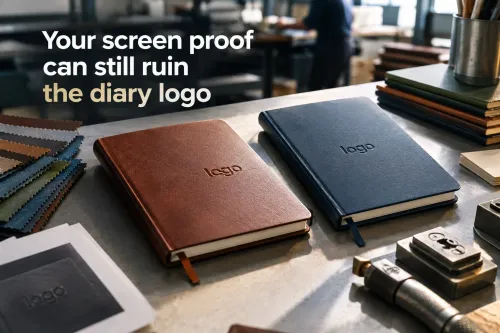
5. Request a physical pre-production sample. A screen proof cannot show final foil brightness, deboss depth, cover texture, paper shade or ribbon colour reliably.
6. For named diaries, approve a signed name, job-title or table-assignment list and one variable-data proof. Check every spelling, sequence, packing label and quantity before authorising bulk production. A final sign-off should record the approved artwork, sample and delivery responsibility.
Give the supplier a brief that exposes cost, risk and responsibility
A supplier brief should name the quantity, delivery addresses, receiving windows, event date, attendee mix and one accountable approver. For custom diaries Bangalore buyers, it should also make every cost and hand-off visible:
- Diary specification: finished size, paper gsm, ruling or dot grid, calendar language, agreed public-holiday calendar, time zone, agenda and contact pages, pocket, pen loop and ribbon count.
- Branding file: vector PDF, AI or EPS with fonts outlined, plus clear space, spot colours, foil colour and emboss or deboss depth.
- Commercial scope: sample, setup, proof, packing, tax, transport, split delivery and rework costs; state whether the price is per unit or total landed cost.
- Responsibility matrix: who approves the physical pre-production sample, checks quantities, supplies attendee names, accepts venue delivery and pays for errors caused by late changes.
| Quotation item | Ask suppliers to show | What it exposes |
|---|---|---|
| Quantity and method | MOQ, setup cost and digital or offset process | Low unit prices that hide large runs |
| Material claim | Recycled-content percentage, FSC chain-of-custody code or packaging specification | “Eco-friendly” without evidence |
| Delivery | One venue, warehouse or split addresses, packing and name matching | Last-mile failure and extra handling |
Compare total landed cost, not unit price: digital printing may suit a small run, while offset, custom endpapers, special paper or moulded packaging need volume. Require a physical sample; a screen cannot prove paper shade, foil brightness, deboss depth, cover texture or ribbon colour.
DRVY ENTERPRISES BLR should be evaluated against the same written brief, sample standard and delivery responsibility as every other bidder.
Related product
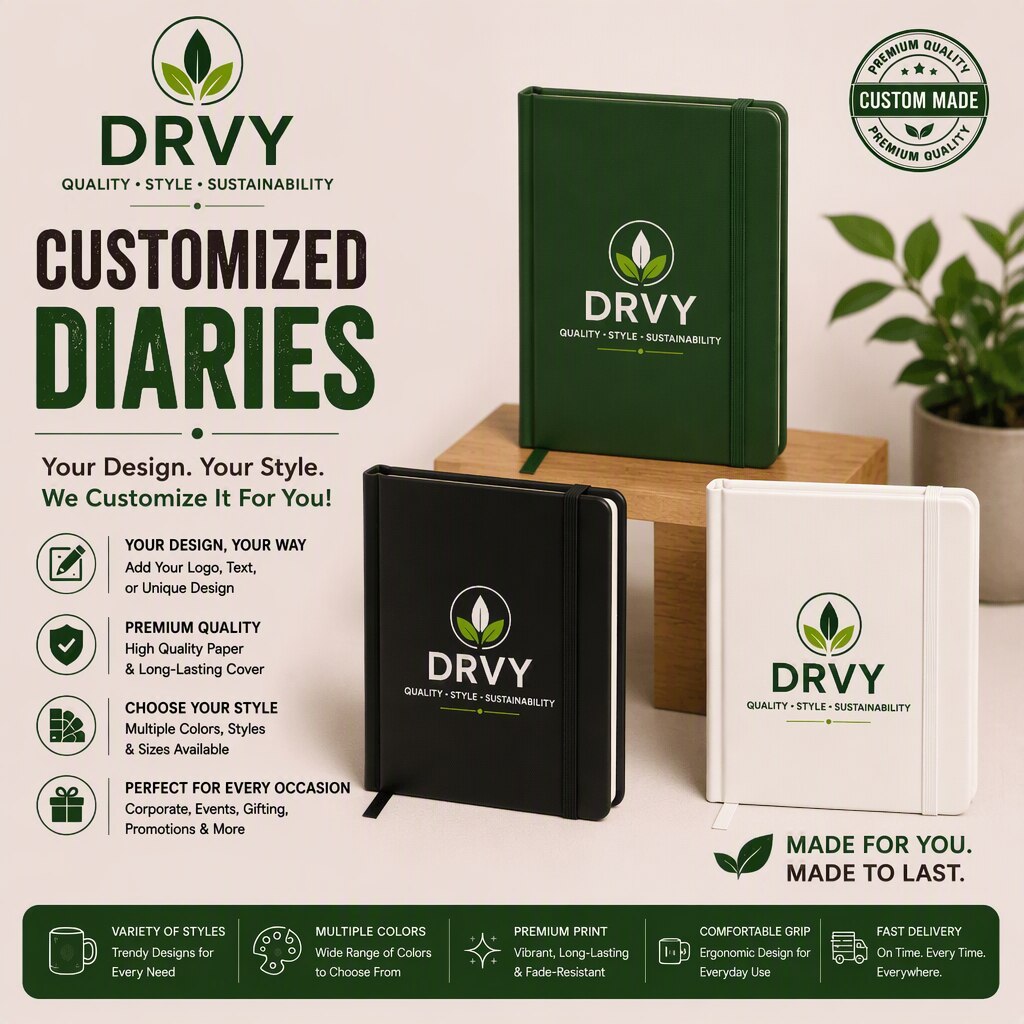 | Customised Diaries Manufacturer in Bangalore, DRVY DRVY specialises in creating personalised diaries tailored for businesses, corporate gifts, events, and promotional... View product → |
Frequently asked questions
Which diary size suits conference and workshop attendees?
Choose A5, measuring 148 × 210 mm, for schedules, speaker notes and sponsor information. Choose A6, measuring 105 × 148 mm, when pocket portability matters more than writing space.
What specifications should event organisers include in a diary quote request?
State the size, paper weight, page count, interior layout, binding type, cover material, printing method, logo treatment, packaging and delivery location.
How should organisers calculate the quantity of branded diaries?
Start with confirmed attendees, then add copies for speakers, staff, sponsors and replacements. Confirm the final count before production so the supplier can schedule materials and delivery.
What should organisers check before approving diary artwork?
Check the logo, colours, dates, sponsor names, page margins, spelling, cover finish and interior layout against the approved artwork and a physical or digital proof.
Keywords