
A branded shirt succeeds only when people are comfortable wearing it, the logo survives washing and the design remains readable at real viewing distance. You will be able to choose the right garment, decoration method, artwork process, quantity and placement for a Bangalore campaign without treating every promotional shirt as the same product.
Key takeaways
- Choose breathable cotton or performance fabric for Bangalore heat and frequent washing.
- Use screen printing for larger runs and embroidery for durable, compact logos.
- Confirm size quantities, names and artwork before approving production.
- Place branding where it stays visible without making the wearer look like a billboard.
Choose the shirt style and fabric for the campaign
Start with the wearer, not the logo. For customised shirts for brand promotion in Bangalore, choose a breathable garment for heat, movement and washing frequency; branded shirts for businesses need a specification beyond “promotional shirts Bangalore” or “custom t shirts Bangalore”.
| Style | Fabric and weight | Fit and best use |
|---|---|---|
| Round-neck T-shirt | Cotton or cotton-rich jersey, 160–180 GSM; 200–240 GSM for a heavier event shirt | Regular fit for outdoor events, campus campaigns and frequent washing |
| Polo shirt | Cotton pique or cotton-polyester pique, 180–220 GSM | Regular or relaxed fit for sales teams, hospitality and client-facing work |
| Full-sleeve shirt | Cotton jersey, 180–220 GSM, or lightweight blended fabric | Regular fit for outdoor teams needing sun coverage; avoid tight cuffs in hot weather |
| Formal shirt | Woven cotton or cotton-polyester, about 110–130 GSM | Regular fit for office staff; choose a breathable weave for Bengaluru’s warm months |
| Workwear shirt | Cotton twill or durable blend, 180–240 GSM | Relaxed fit with movement allowance for technicians, drivers and repeated use |
Treat GSM as fabric weight, not a complete quality specification. State fibre composition, knit or weave, acceptable shrinkage, colourfastness, pilling performance, size tolerances and intended decoration in the brief. A pre-production sample must confirm the actual colour, collar shape, logo scale, placement and stitching; wash it before approving the full order.
Match the decoration method to the logo and order size
Choose the decoration by logo complexity, fabric and quantity—not by the cheapest quote. Screen printing suits large runs of identical shirts with bold artwork; setup costs are spread across more pieces, but each colour needs a screen.
| Method | Best fit | Main limitation |
|---|---|---|
| Screen printing | Large batches, solid colours | Setup is inefficient for small or personalised orders |
| Heat-transfer vinyl | Small runs, names and simple one-colour logos | Limited detail and a plastic feel |
| Direct-to-film | Small or medium runs, multicolour artwork on varied fabrics | Transfer can feel noticeable on the shirt |
| Direct-to-garment | Detailed artwork or photographs on cotton | Needs suitable fabric and careful pretreatment |
| Embroidery | Polo shirts, jackets and durable small logos | Fine detail and large designs can distort or add weight |
| Sublimation | White or light polyester, including all-over designs | Does not suit cotton or dark garments |
Search results for custom t shirts bangalore do not specify fabric, decoration or quantity. For personalised company t shirts, lock every name, department and employee number before production; one incorrect file can create a separate reprint.
- Supply vector artwork, the intended garment colour and physical colour references; RGB or HEX values alone are not production specifications.
- Request a physical strike-off or pre-production sample on the actual shirt. Check logo scale, placement, thread or print colour, stitching and collar shape.
- Wash the sample under the intended conditions and issue care instructions using recognisable symbols from ISO 3758:2012. Reconcile ordered, printed and packed quantities before dispatch.
Plan sizes, quantities and personalised details before production
Do not order from a headcount alone: people who have not submitted sizes, late joiners and replacement needs can create both shortages and dead stock. Use a garment-specific size chart, not employees’ usual clothing labels, because cuts differ between suppliers.
1. Send a form showing chest measurement, shirt style, fit and available sizes. Ask each person to measure a well-fitting shirt or their chest, select one size, and confirm the required quantity by a fixed deadline.
2. Separate confirmed sizes from estimates. Build the order from confirmed responses, then add a small reserve for late replacements and size exchanges; keep that reserve concentrated in common sizes rather than adding the same percentage to every size.
3. Reconcile the numbers before production: total requested, total ordered, each size, each personalised name, department and employee number. For personalised company t shirts, lock the spelling, font, colour and artwork version in one approved list.
4. Check the supplier’s written brief for garment colour, fibre composition, GSM, size range, decoration method, packaging and delivery date. “Branded shirts for businesses” is not a specification, and a vague brief invites substitutions.
Count again when goods arrive. Match cartons to the packing list, then verify that the quantities printed, packed and invoiced agree; this catches missing names and duplicate shirts before distribution. Use a physical pre-production sample for named shirts, not only a digital mock-up.
Place logos and messages without making the wearer a billboard
Keep the primary logo at the left chest, where it remains visible in conversations without dominating the shirt. Reserve the back for information people need to read at a distance, not a second oversized logo.
Use this layout for personalised company t shirts:
- Primary logo: left chest, with a measured distance from the collar and side seam.
- QR code: upper back or sleeve on a flat, light-coloured panel; test scanning from one metre.
- Name: right chest, aligned with the logo rather than floating below it.
- Department: directly beneath the name in a smaller, high-contrast type size.
- Sponsor marks: one sleeve or a narrow lower-back row, with equal spacing and consistent sizing.
Specify every position on a placement template. “Left chest” alone allows seams, pockets and polo plackets to shift the artwork. Approve a physical sample before production, checking logo scale, garment colour, collar shape, stitching and a wash-tested print.
Searches for promotional shirts Bangalore cover budget tees, polos and formal shirts, so state coordinates and artwork rules in the brief. If the design needs several sponsor marks, a large QR code or extensive copy, choose a tote bag, event lanyard or banner instead; these give information more room without turning clothing into advertising space.
Approve a production sample and lock the supplier brief
Approve a physical pre-production sample, not just a digital mock-up. Check the actual garment colour, collar shape, stitching, logo scale and placement; screen-print colours and print dimensions can look different on a monitor. Wash the sample using the intended care method, then inspect shrinkage, twisting, pilling, colour bleeding, print cracking, peeling and loss of colour.
Record these details in the supplier brief:
- Fibre composition, knit construction, GSM, garment colour, fit, size range and acceptable size tolerances.
- Decoration method, artwork version, print or embroidery dimensions, placement measurements and approved physical colour strike-off.
- Wash-test result, acceptable shrinkage, colourfastness requirement and care-label wording.
- Quantity by size and personalised detail, including the final spelling list for names, departments or employee numbers.
- Delivery date, individual packaging, size labels, folding method and the process for replacing defects.
- Reconciliation of ordered, printed and packed quantities before dispatch.
For customised shirts for brand promotion in Bangalore, this brief prevents “premium” claims from replacing measurable checks. Give DRVY ENTERPRISES BLR the approved sample and final artwork list, then require written confirmation that production matches both. The same discipline applies to promotional shirts Bangalore orders, whether they are budget tees, polos or formal shirts.
If the sample fails after washing, approve nothing until the supplier corrects the process or garment.
Related product
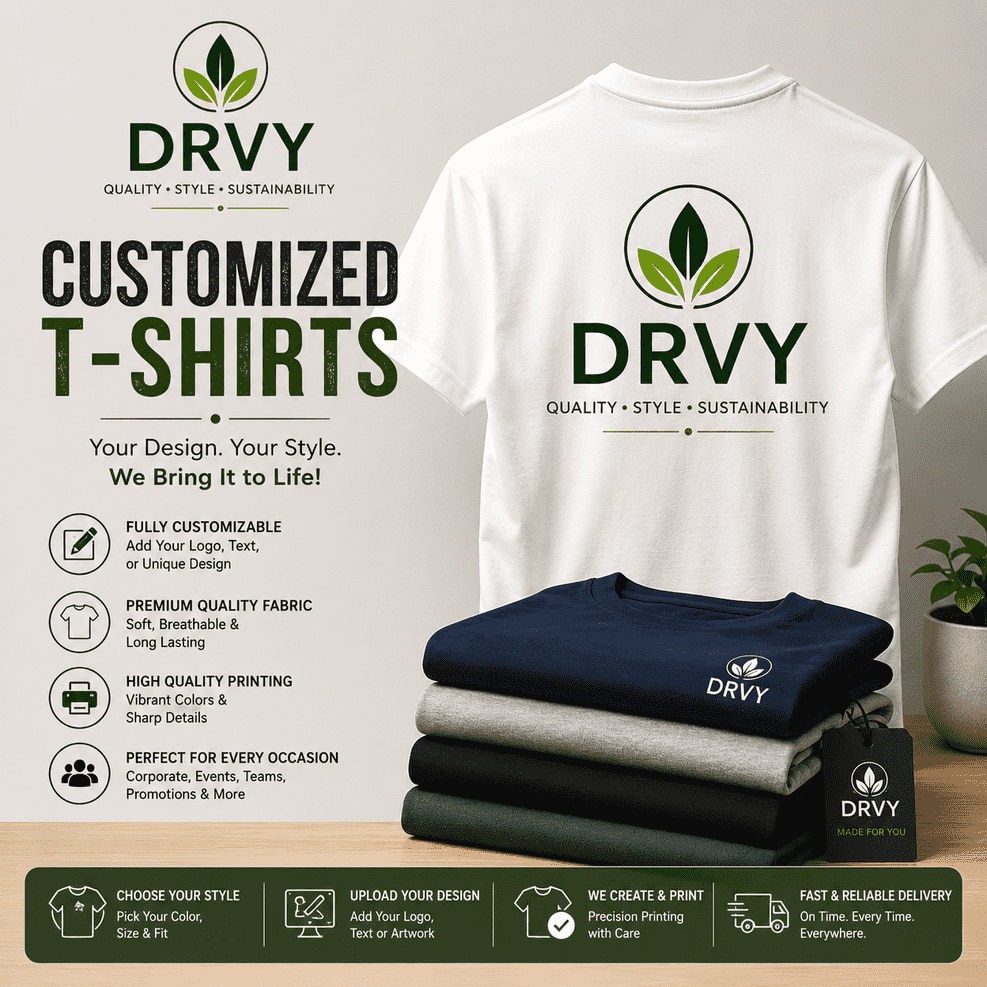 | Customised T-Shirt Manufacturer in Bangalore, DRVY At DRVY, we specialise in custom T-shirts for businesses, brands, events, teams, institutions, and promotional... View product → |
Frequently asked questions
Which shirt fabric works best for brand promotion in Bangalore?
Choose breathable cotton for comfort or moisture-wicking performance fabric for outdoor work, active teams and frequent washing. Match the fabric to heat, movement and care requirements.
Which decoration method should you use for branded shirts?
Use screen printing for bold artwork and larger quantities, embroidery for compact logos and a raised premium finish, and digital printing when the design has detailed colours or smaller runs.
How should you plan sizes and quantities for personalised company T-shirts?
Collect a size breakdown before production, include a fitting sample, and separate quantities by colour, size, department, name and other personalised details.
Where should you place a logo on promotional shirts?
Use the left chest for a restrained corporate mark, the back for a larger event message, and the sleeve for secondary information. Check visibility, comfort and how the artwork looks when worn.
Why approve a production sample before ordering promotional shirts?
A sample lets you check fabric, fit, colour, decoration size, logo position, spelling and wash-care details before the full order is made.
Keywords